; ?>/img/banner-blog.jpg)
Why Dielectric Grease and Coaxial Connections Matter for Christmas Lighting in Northeast Florida
In Northeast Florida, where Jacksonville averages 53 inches of rain per year, Christmas lighting fails at the connections. Male-female plug connections without dielectric grease let moisture in, trip GFCI breakers, and take down entire rooflines and palm tree runs sometimes for days. Coaxial connections sealed with dielectric grease are what keep a professional display running from Thanksgiving to New Year’s without a single outage call.
Most people don’t think about how their Christmas lights are wired together. They see the finished display, they love the glow on the roofline, and they assume the whole thing just works. And when it doesn’t when a 30-foot run of palm tree wrapping goes dark on December 18th, or the front roofline trips the GFCI at 11 PM on the night of the neighborhood holiday party they find out the hard way what was wrong at installation.
We’ve seen it happen to HOA communities across Northeast Florida more times than we can count. The lights look great in November. The weather cooperates for a few weeks. Then a good rainstorm rolls through, and suddenly half the display is out and nobody knows why.
The answer is almost always the same: wrong connections, no dielectric grease, and a Florida climate that punishes both without mercy.
Northeast Florida Doesn’t Take Breaks From Rain Even in December

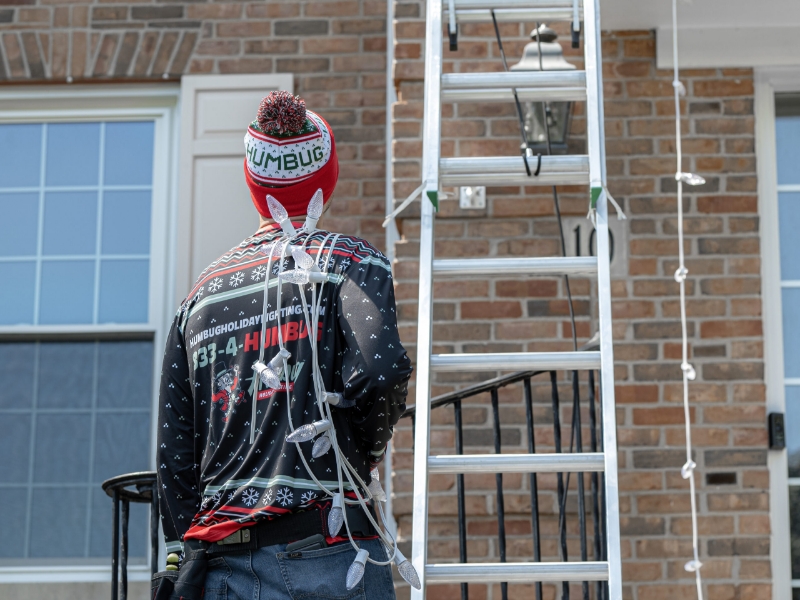
The Humbug crew arrives fully stocked — every connection sealed before a single strand goes on the roofline.
Jacksonville averages 53 inches of rain per year, according to the National Weather Service. That puts Northeast Florida among the wettest metro areas on the East Coast – wetter than Miami, wetter than Tampa, and wetter than the national average by roughly 13 inches. Even November, which is historically the driest month in the area, still averages nearly 2 inches of precipitation.
The install window for Christmas lighting runs from October through early December. Every display we put up goes through at least one good rainstorm before it comes down in January. A display with properly sealed connections holds all season. A display with exposed male-female connections may last a few weeks before moisture finds its way in and the GFCI trips.
What makes this worse in Florida specifically is the humidity. Even on dry days, the ambient moisture in the air – particularly in coastal communities from Ponte Vedra to Amelia Island – works on unprotected connections the same way a slow drip does. It isn’t just rain you’re guarding against. It’s 80% humidity in October and a climate that rarely gives outdoor electrical connections a true dry-out window.
The Connection Problem: Why Male-Female Plugs Fail

Every Humbug technician works the roof in a full safety harness — the difference between a professional install and a handyman with a ladder.
Most consumer Christmas lights – and even some installer-grade products – use standard male-female connections to link one strand to the next. You’ve seen them: the two-prong plug that pushes into the socket on the end of the next strand. They work fine indoors. Outside in Northeast Florida, they’re a liability.
Here’s what happens. The prong-and-socket design creates a gap between the male and female ends where the two connect. Water doesn’t need much of an opening. On a rainy night in December, moisture works into that gap, creates a current path between the prongs, and the GFCI breaker does exactly what it’s designed to do – it trips to prevent a ground fault.
In a residential install, that means a homeowner is outside in the rain at 10 PM resetting a breaker. In an HOA or CDD, where a single circuit may power rooflines, palm tree wraps, and common area displays across multiple buildings, a single tripped GFCI can take down everything on that run. We’ve seen 30-foot palm trees go dark. We’ve seen entire rooflines on HOA buildings go out for three and four days because the installer’s maintenance response time was measured in days instead of hours.
The connection type is the cause. The response time is just the consequence.
What Dielectric Grease Actually Does

Two-man rooftop teams mean every connection point gets attention before the circuit is live.
Dielectric grease is a silicone-based compound that seals electrical connections against moisture and corrosion without interfering with current flow. It’s non-conductive, which means it sits at the perimeter of a connection rather than on the contacts themselves, creating a physical barrier water can’t breach.
Applied correctly to a male-female Christmas light connection, it fills the gap between plug and socket, preventing moisture from reaching the metal contacts and forming that unintended current path that trips the GFCI. It also guards against salt air corrosion, which matters in Ponte Vedra and along the Nassau County coast, where salt content in the air is measurably higher than inland communities.
The application is simple, but it has to happen at installation. A thin coat inside the female socket before the prong goes in, a layer around the joint after it’s seated. Christmas Designers, one of the most-referenced professional installation training resources in the industry, notes that dielectric grease has consistently outperformed moisture-displacement sprays in field testing for GFCI trip prevention. It’s not a shortcut. It’s a standard that separates professional installs from installs that look fine until it rains.
What it can’t do is compensate for the wrong connection type to begin with. Dielectric grease on a poor-quality male-female connection is better than nothing. A coaxial connection with dielectric grease is what actually holds.
Coaxial Connections: The Right Starting Point

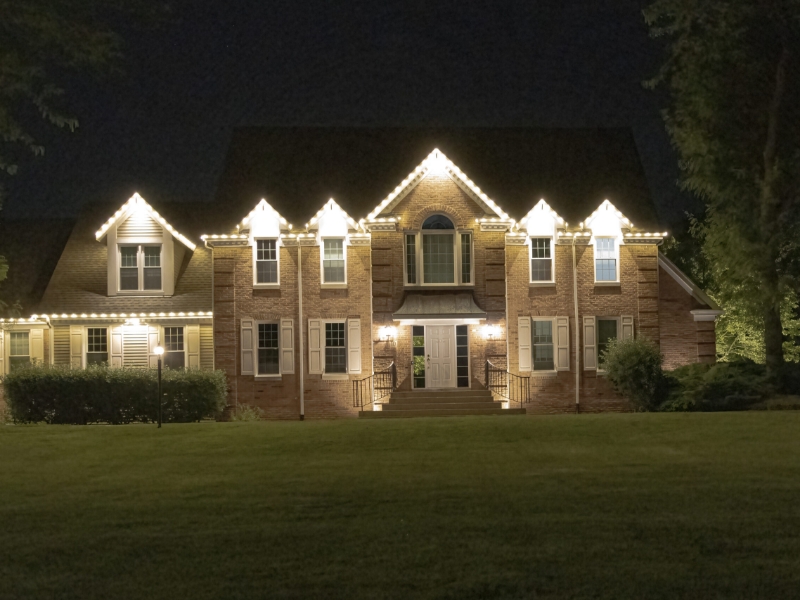
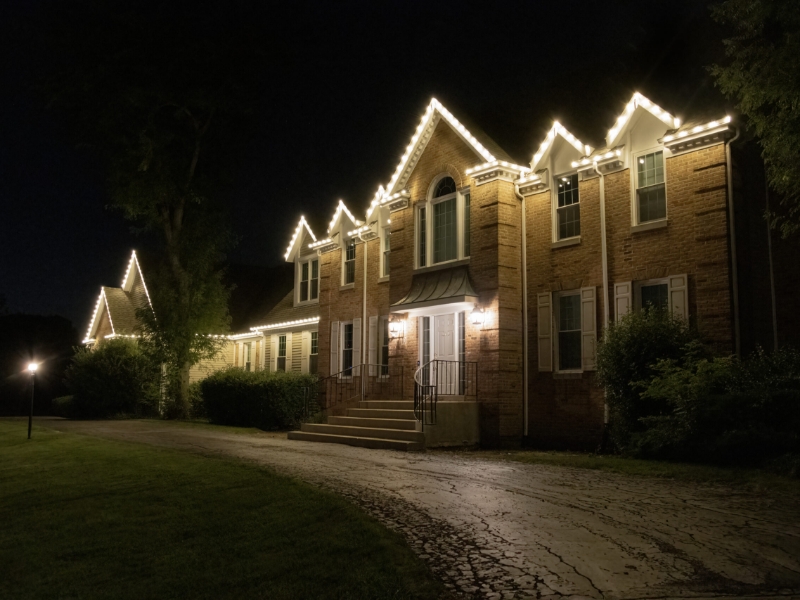
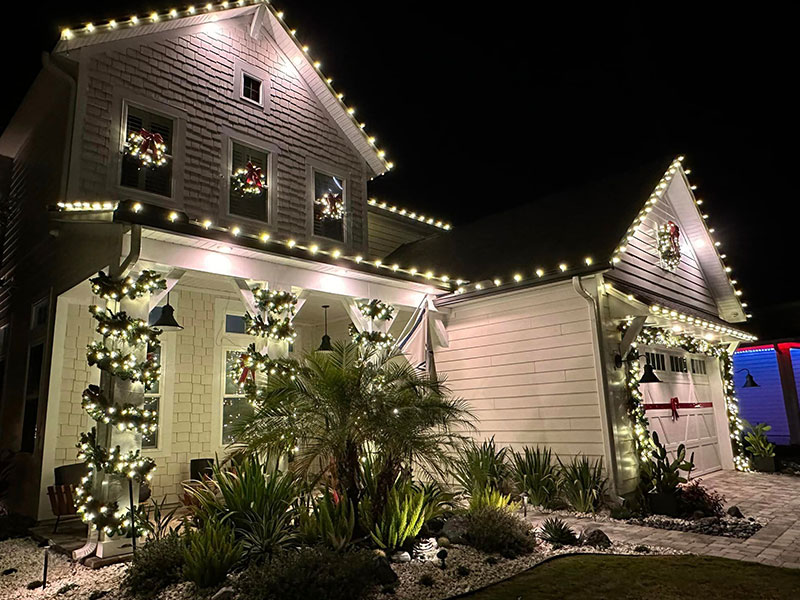
Clean rooflines, wrapped palms, zero visible wire runs — this is what a properly installed display looks like, and holds like, all season.
A coaxial connection is purpose-built for outdoor environments. The design locks the male and female ends together with a twist-and-seat mechanism that physically closes the gap between them. There’s no open joint for moisture to enter. The connection is watertight by design, not by hope.
For Christmas lighting in Northeast Florida, this matters for three reasons.
First, the joint itself is mechanically secure. A standard plug-and-socket connection can loosen over the course of a season as the wire is pulled by wind, adjusted by maintenance, or stressed by thermal expansion and contraction. A coaxial connection stays seated.
Second, the watertight seal works in tandem with dielectric grease rather than depending on it alone. Even in particularly exposed areas — rooflines, palm tree wraps, any run that takes direct rainfall — adding dielectric grease inside a coaxial connection before seating it provides an additional layer of defense that non-coaxial systems simply can’t match.
Third, coaxial connections don’t give you a false sense of security mid-season. Male-female connections can look fine on a dry day and fail the first rainy night. A properly sealed coaxial connection behaves the same on a dry Tuesday in November and a wet Saturday in December.
For HOA and CDD properties specifically, this consistency is what keeps property managers from fielding resident complaints. When a roofline runs 200 feet and powers a coordinated community display, the stakes of a single failed connection are high. One tripped GFCI doesn’t take out a single strand. It takes out the run.
What This Looks Like on an HOA Property

Clean rooflines, wrapped palms, zero visible wire runs — this is what a properly installed display looks like, and holds like, all
season.
Picture a 40-home section of a Nocatee community. The Christmas lighting installer used standard male-female plug connections throughout, no dielectric grease, good product otherwise. The display goes up mid-November and looks clean. Then the first significant December rain comes through — the kind of rainstorm Northeast Florida gets several times a month, 1 to 2 inches overnight. By morning, one building’s roofline is dark. Two palm trees are out. A string of bistro lights across the community entrance is dead.
The installer’s team doesn’t respond until the following afternoon. By then, the property manager has fielded calls from six residents and a board member. When the installer finally arrives, the fix takes 20 minutes: dry out the connections, reseat them, reset the breakers. The root cause isn’t addressed. Three weeks later, after another rainstorm, it happens again.
We’ve had property managers come to us with exactly this story, not one installer by name, but a pattern that shows up across HOA accounts in St. Johns County, Duval County, and Nassau County with enough consistency to be a category problem. The connection type was wrong. The maintenance response was slow. Neither issue is acceptable for a property that depends on looking its best from Thanksgiving through New Year’s.
How Humbug Builds It

Every install ends the same way — the crew walks the customer through the finished display before they leave the property.
Every display we install in Duval, St. Johns, Clay, and Nassau counties uses coaxial connections as standard. Dielectric grease goes on every connection before it’s seated. It’s not an upgrade. It’s what we decided a professional install in Florida requires, and we haven’t changed that standard since we started.
The reason is simple: we own the lights, and we own the maintenance. When a strand goes out mid-season, we’re the ones who come back to fix it, same day or next day, no charge. That means every installation decision is also a maintenance decision. A connection type that fails in the rain is a call we have to answer in the rain. We’d rather get it right on the way up.
For HOA and commercial clients, this approach is what keeps their phones from ringing in December. The display runs. If something does happen, we’re there fast. That’s the standard we hold to, whether it’s a single-family home in Ponte Vedra or a CDD with 400 units in Nocatee.
If you’re evaluating Christmas lighting companies and want to know how any installer approaches connections and moisture protection, ask them directly: what connection type do you use, and do you apply dielectric grease at every joint? The answer tells you a lot about what December is going to look like.
professional Christmas lighting Northeast Florida
Ready to Get It Right This Season?
Northeast Florida’s weather isn’t going to change. A display built on the right connections, sealed correctly, and backed by a team that shows up when something goes wrong is the only one worth having.
See how Humbug’s Christmas lighting service works – and what’s included every season
FAQs
What is dielectric grease and why do you use it on Christmas lights?
Dielectric grease is a silicone-based sealant that creates a moisture barrier at electrical connection points. Applied to Christmas light connections, it prevents water from forming an unintended current path between exposed prongs, which is the most common cause of GFCI trips during rainstorms. In a climate like Northeast Florida’s, where annual rainfall averages 53 inches, it’s a non-negotiable part of a professional install.
What’s the difference between a coaxial connection and a standard male-female connection for Christmas lights
A standard male-female plug connection pushes together and relies on friction to stay seated, leaving an exposed gap where moisture can enter. A coaxial connection locks together with a twist-and-seat mechanism that physically seals the joint. In outdoor applications, the coaxial design is significantly more resistant to moisture intrusion, and when paired with dielectric grease, it provides a watertight seal that standard plug connections can’t match.
Why do GFCI breakers trip during rain when Christmas lights are on?
GFCI breakers trip when they detect current leaking to ground. In Christmas lighting, this happens when moisture enters an unsealed connection point, creates a conductive path between the exposed metal contacts, and allows current to take an unintended route. The breaker is doing its job correctly — but the underlying cause is a connection that wasn’t sealed against water at installation. Coaxial connections with dielectric grease prevent the moisture intrusion that triggers the trip.
Does this problem happen more in Florida than in other states?
Yes. Northeast Florida averages 53 inches of rain per year and maintains high humidity levels throughout the Christmas season, which runs October through January here. Many states that dominate the Christmas lighting industry have cold, dry holiday seasons where moisture isn’t a factor. Florida installers who don’t adjust for the climate — using connection types and sealing protocols designed for wet environments — are applying cold-climate practices to a subtropical one.
How does improper connection type affect HOA Christmas lighting specifically?
In HOA and CDD communities, a single Christmas lighting circuit often powers rooflines, palm tree wraps, and common area elements across multiple buildings. A tripped GFCI on an unsealed male-female connection doesn’t take out one strand — it takes out the entire run. Property managers then field resident complaints while waiting on an installer’s maintenance team. Properly sealed coaxial connections eliminate the failure mode. Fast maintenance response handles anything that still comes up.
How do I know if my current Christmas lighting installer is using the right connection type?
Ask them directly: do you use coaxial connections, and do you apply dielectric grease at every joint? A professional installer who has worked in Florida’s climate will know immediately why you’re asking and will be able to answer both questions without hesitation. If they use standard male-female plug connections and don’t mention dielectric grease, you now know what’s likely to happen the first time it rains.
Back
 Joseph L.